Skip to content
Start free
Back to Blog

Custom Scraper vs Data Extraction Tools

Sergiu InizianLast updated on 13 min read
Custom Scraper vs Data Extraction Tools
TL;DR: Build a custom scraper when your extraction logic, deployment constraints, or source coverage require control you cannot get from a tool. Buy the collection capabilities that do not differentiate your product, then compare both approaches on fresh, valid records delivered, engineering maintenance, and the ability to switch later.

A custom scraper is software your team designs and maintains to collect website data for a specific requirement. Data extraction tools provide some of that capability through a visual interface, hosted API, or managed delivery service. The custom scraper vs data extraction tools decision is therefore a question of responsibility: which parts of the collection pipeline should your developers own?

Both options automate the same pipeline, which our explainer on what web scraping is lays out for teams new to the technique. For the jobs that the pipeline usually serves, see what web scraping is used for.

Imagine a product team that needs daily prices from public supplier catalogs. A script that extracts a price from one page proves that the field is accessible. It does not prove that the team can collect every required variant, distinguish a sale from a formatting change, or recover a missed delivery before the next reporting run.

The right comparison starts with that delivery requirement. A custom implementation might fit it well. A hosted service might remove the hardest operational work. A combination might let you keep your product logic while outsourcing page retrieval. This guide gives you a decision matrix, a cost model, and a pilot plan for choosing between those options without relying on vendor benchmarks or assuming engineering time is free.

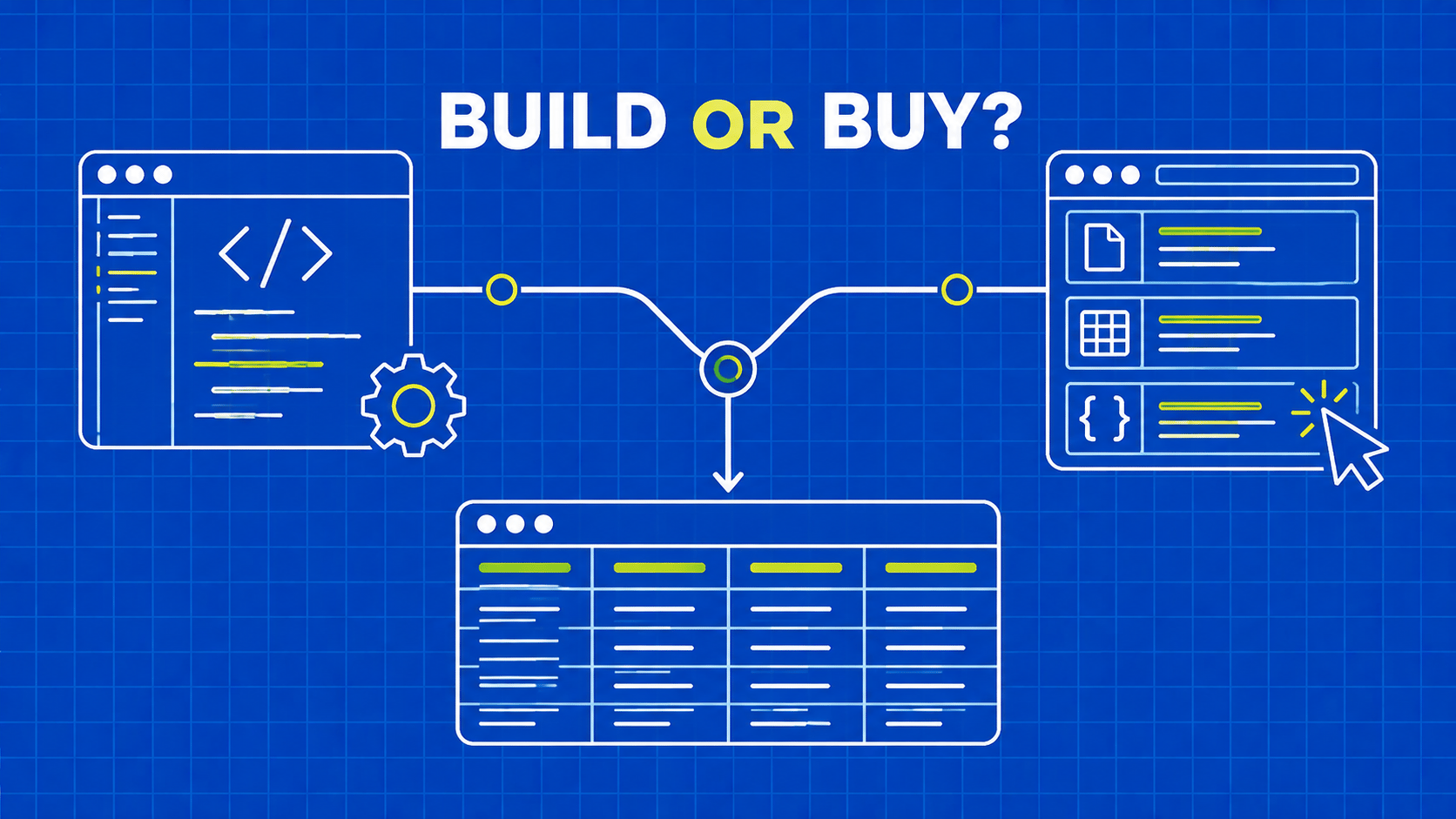
Custom scraper vs data extraction tools: compare ownership first

“Build” does not mean writing an HTTP stack from scratch. You can build a custom scraper on mature open-source libraries while owning the application that connects them. Similarly, “buy” does not automatically mean receiving a complete, validated dataset. The service boundary matters more than the label on the product.

Approach

What your team typically owns

What another component or provider supplies

Main evaluation question

Custom scraper

Source logic, deployment, validation, scheduling, incident response

Libraries and infrastructure primitives

Can we maintain this reliably?

Visual extraction tool

Task configuration, field mapping, downstream checks

Visual interaction and extraction workflow

Can it express every required case?

Retrieval or browser API

Parsing, data contracts, orchestration, consumer integration

Page retrieval or browser execution, within its documented scope

Does it remove our actual bottleneck?

Structured extraction API

Input selection, mapping, acceptance checks

Parsed fields for supported targets

Are fields and coverage sufficient?

Managed data delivery

Requirements, acceptance, downstream use

Contracted collection and delivery responsibilities

Who resolves incomplete or late data?

These are starting assumptions, not universal product definitions. Ask each provider to mark which responsibilities its specific plan covers. A browser API may supply the browser but leave interaction scripts to you. A visual tool may support scheduling but require manual repairs after a page redesign.

The Scrapy architecture documentation makes the separation concrete: scheduling, downloading, spider processing, and item pipelines are different components. Replacing one component does not replace the entire system. Use those boundaries when comparing a custom crawler with a hosted extraction tool.

Before shortlisting either, check whether an official API, licensed feed, or permitted export already supplies the required data. Test its coverage and freshness against your requirement. If it fits, maintaining page extraction may be unnecessary. If it omits important fields, document those omissions rather than treating scraping as the default for every source.

Define the dataset before selecting the scraper

A precise data contract makes build-versus-buy discussions much shorter. “Collect product prices” leaves too much room for incompatible implementations. A useful requirement says which products, offers, locations, currencies, and observation times count, plus what to do when a value is unavailable.

Start with a small record that both a custom scraper and a data extraction tool can produce. The following is an illustrative contract example, not output from a real collection run:

{
  "schema_version": "1",
  "source_url": "https://catalog.example/products/widget-blue",
  "source_product_id": "widget-blue",
  "variant_id": "blue-small",
  "observed_at": "2026-09-10T08:00:00Z",
  "price_amount": "24.90",
  "currency": "EUR",
  "availability": "in_stock",
  "extraction_status": "complete"
}

Specify whether price_amount includes tax or delivery, whether an unavailable item can have a null price, and how a variant differs from its parent product. Keep monetary values in a representation your downstream system handles deliberately; the decimal string here is a design choice, not a requirement for all pipelines.

Separate structural validation from truth. JSON Schema can declare required properties and constrain object structure, but a structurally valid record can still contain the wrong price. The JSON Schema object reference explains that properties are not required merely because they appear in properties; required fields need an explicit required declaration.

Also write acceptance rules for the dataset as a whole. How many expected products were observed? Which sources were missed? How old may a record be at delivery? What happens when pagination returns the same page twice? A field-level schema cannot answer those questions alone.

Assign an owner to each ambiguous field before the pilot. If finance and analytics disagree about tax-inclusive prices, no extraction platform can choose the correct business definition for them. Resolve that disagreement once in the contract, then make both implementations pass the same checks.

When building a custom scraper makes sense

Build when the parts you need to control are central to the result. Examples include unusual multi-page relationships, specialized normalization rules, strict deployment requirements, and source workflows that available tools cannot express. A team with established collection infrastructure also starts from a different position than a team maintaining its first recurring scrape.

Custom extraction is particularly useful when you need to explain how a field was derived. You can version selectors and transformations, retain permitted evidence, and reproduce a parser decision against a saved fixture. That control helps distinguish a source change from your own regression. It only provides value if the team actually implements the versioning and retention process.

For mostly static pages, begin by determining whether a direct HTTP request contains the required information. Our guide to Python HTTP clients helps with that retrieval choice. For discovery across many linked pages, a crawling framework adds a different set of capabilities; the Scrapy tutorial is a practical next step.

JavaScript interaction changes the workload. Playwright checks relevant actionability conditions before actions and raises a timeout if those conditions do not pass in time. That behavior can help synchronize interactions, but it is not proof that all business data has loaded. Your scraper still needs explicit readiness and extraction checks. See the Playwright auto-waiting documentation.

The strongest argument against building is often organizational. A repository without a maintenance owner is not a production capability. Name the team that handles broken sources, dependency updates, deployment failures, and failed acceptance checks. Reserve capacity for those tasks instead of assuming the original author can absorb every interruption.

Do not build solely because the first parser looks easy. Build because the required control has a measurable benefit and you can sustain the resulting obligations. If those obligations compete with work that matters more to your product, narrow the custom portion of the system.

When a data extraction tool is the better fit

Choose a tool when it covers the necessary sources and fields, shortens delivery time, and removes work your team does not want to operate. The case is strongest when your requirements fit its supported workflow without extensive exceptions. Every exception should be visible in the evaluation, because a mostly configured solution can still leave a difficult maintenance tail.

A visual tool may be enough for a repeatable research export with a modest number of page patterns. Developers should still inspect its output contract, export process, scheduling behavior, and failure notifications. “No code” describes an interface; it does not establish data completeness or make the result suitable for an unattended production job.

A retrieval API fits a different problem: you already know how to parse the required data, but operating retrieval is consuming time. A structured API moves the boundary farther downstream by providing fields rather than raw pages. Confirm exactly which target types and field semantics it supports, especially for variants, regional content, or missing values.

Ask operational questions using failure examples. If half of a scheduled job finishes, can you identify the missing inputs and retry them? If the provider changes a field, how much notice do you receive? If a job returns a successful status but an empty dataset, which support or remediation process applies? An availability commitment and a data-quality commitment are different promises.

Finally, examine exportability. Keep your source list, record identifiers, mapping rules, and acceptance tests in systems you control. Request an example export before adopting a proprietary project format. Buying extraction should reduce operational effort without making your downstream application depend on an undocumented response shape.

Compare total cost per usable record

Neither an open-source license nor an API price tells you the full cost of web data extraction. Compare the same scope over the same planning period, using inputs from your team and measurements from a representative pilot. Do not combine a one-time prototype estimate for building with a fully operated service quote for buying.

For a custom scraper, include development, infrastructure, maintenance, incident handling, and data remediation. For a tool, include subscription or usage charges, integration, any work outside the service boundary, support requirements, and exit costs. Avoid counting the same engineering hours twice when maintenance and incident categories overlap.

Cost input

What to measure or estimate

Common omission

Initial implementation

Source onboarding, validation, deployment, integration

Work after the demo succeeds

Recurring operation

Compute, storage, network, API or plan usage

Retries and rendered requests

Maintenance

Parser repair, dependency work, configuration repair

Sources that change unevenly

Quality remediation

Investigation, backfills, consumer corrections

Successful responses with wrong data

Change or exit

New sources, schema changes, export and migration

Proprietary workflow replacement

Use a denominator that reflects your objective. For recurring extraction, a useful metric is cost per usable record: allocated collection cost divided by the number of distinct records that pass your quality rules and arrive within the freshness requirement. A response returning HTML is not yet a usable record.

Keep the calculation transparent. If a pilot retrieves the same product repeatedly, decide whether each observation represents new business value before counting it. If one category produces most failures, report that category separately. An aggregate success rate can hide a source that is essential to the product but expensive to maintain.

Run at least a base case and an adverse case with your own inputs. In the adverse case, increase the maintenance effort, retry volume, or onboarding work that looks uncertain. The objective is not a precise forecast from thin evidence. It is to identify which assumption would change your build-or-buy decision, so the pilot can test that assumption directly.

Run a pilot that can expose failure

Give both candidates the same approved target set, required fields, schedule, and quality rules. Include representative page types and known edge cases, not only the easiest pages. A useful sample might include products with variants, unavailable items, pagination boundaries, and fields that are legitimately missing.

Create a small reference set that a person has checked against the source at a recorded time. Use it to evaluate extraction correctness separately from HTTP or job success. Recheck time-sensitive values when evaluating a later run; otherwise a legitimate price change can look like an extraction error.

Measure delivery, correctness, and operator effort

Record coverage, field accuracy, freshness, duplicate rate, and failed inputs. Keep definitions beside the numbers. For example, coverage can mean expected source records observed, while field accuracy can mean checked field values matching the reference observations. Those are different measurements, and neither should be presented as a universal benchmark from one pilot.

Track the human work too: configuration changes, debugging, reruns, and support exchanges. Ask the developer responsible for operations to reproduce a failed job. If recovery depends on knowledge held by one person, include that dependency in the decision.

Test recovery without stressing the source

Use saved, permitted fixtures to simulate missing fields, changed markup, and duplicated records. Test delivery retries against your own endpoint or local harness. You can learn about recovery without intentionally generating excessive traffic or provoking a third-party service.

Set bounded concurrency and an explicit request policy for live checks. Scrapy's AutoThrottle adjusts delays using response latency and respects configured concurrency and delay limits. It is a mechanism you configure, not a substitute for deciding acceptable request behavior. See the AutoThrottle documentation.

Before the pilot ends, have the consumer process the delivered data. A CSV that looks good in a spreadsheet may still fail your importer or collapse distinct variants into one identifier. The final acceptance event is a useful downstream result, not the extraction tool reporting that its task completed.

Use a hybrid design when responsibilities split cleanly

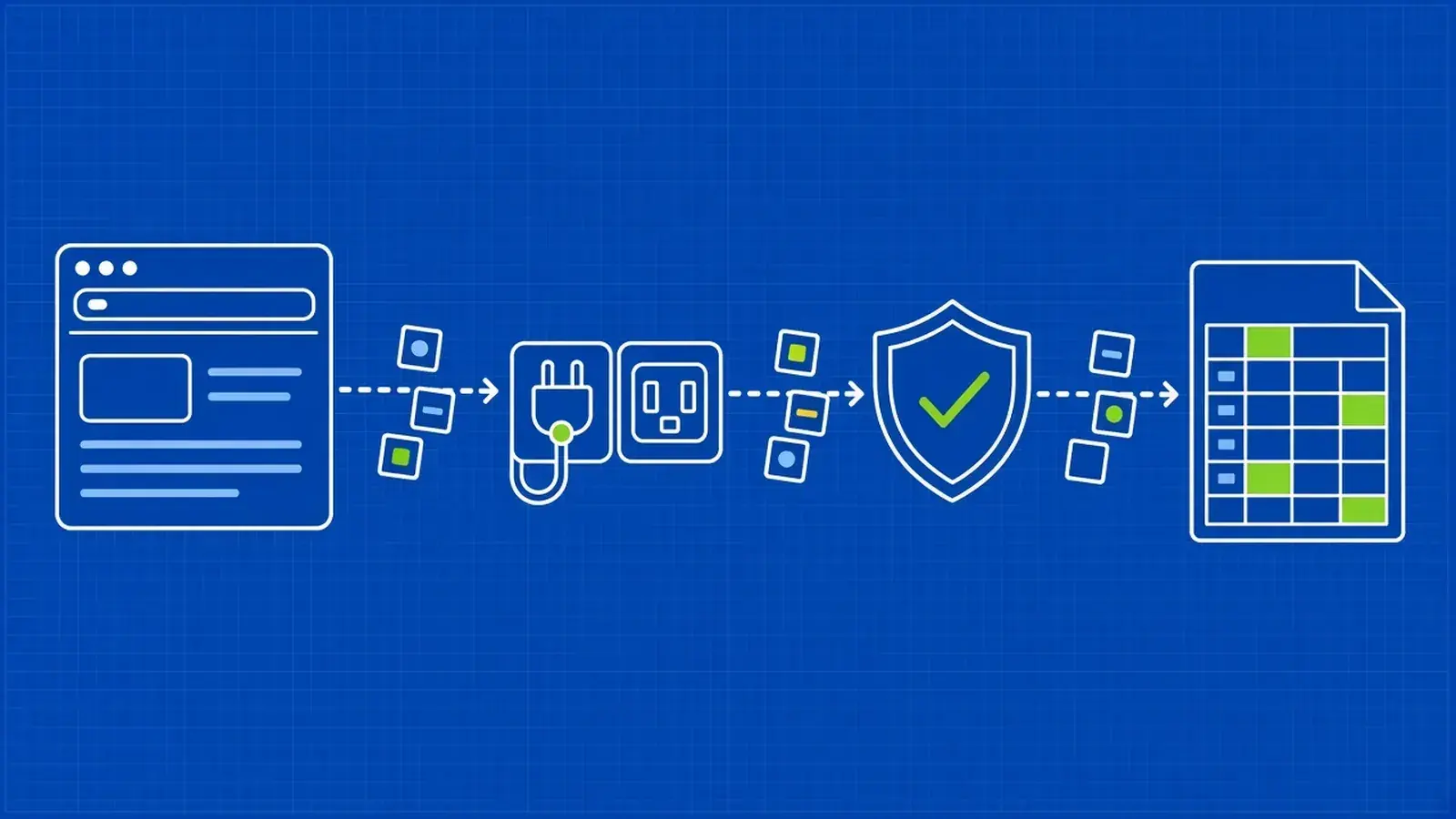
A hybrid pipeline lets you buy retrieval or browser execution while maintaining the extraction rules that matter to your application. Put the boundary behind an adapter that accepts a documented input and returns a normalized result. Your consumer should not need to know which retrieval provider handled an individual source.

Keep discovery, retrieval, parsing, validation, and delivery separable where practical. If the provider returns HTML, your parser can operate on it and on stored test fixtures. If the provider returns structured data, map that response into your own schema before it reaches consumers. Preserve enough provenance to explain where the record came from and which transformation produced it.

Validation belongs on your side of this boundary even when a provider performs its own checks. The Scrapy item pipeline documentation shows validation and duplicate filtering as explicit processing responsibilities. The broader design lesson is useful across tools: delivery should happen after acceptance logic, not simply after a response arrives.

Avoid claiming portability because two integrations share a function name. Test that they produce equivalent fields under the same conditions. Different rendering behavior, geography, or session state can change the underlying page. For interaction-heavy sources, the Scrapy and Playwright guide provides further implementation context.

Keep a short source register with the approved purpose, target scope, request policy, and review owner. Follow applicable access requirements and review uncertain cases before collection. Robots rules are useful crawler instructions, but they do not establish access authorization; RFC 9309 explicitly distinguishes the two. Outsourcing retrieval does not resolve that decision for your team.

Key Takeaways

  • Choose the ownership boundary first: retrieval, parsing, validation, scheduling, and delivery are separate responsibilities.
  • Define fields, coverage, and freshness before comparing a custom scraper with an extraction tool.
  • Estimate cost per distinct, valid, timely record using your own workload and engineering costs.
  • Include difficult cases and recovery work in the pilot, then test the downstream import.
  • Keep schemas, provenance, and acceptance checks under your control so a future switch remains practical.

FAQ

Should historical data be part of the same purchasing decision?

Evaluate historical coverage separately from ongoing collection. A tool that captures today's pages cannot necessarily reconstruct values that disappeared before collection began. Ask for the actual observation dates, collection method, permitted uses, and gaps in any historical dataset. Compare that evidence with your analytical requirement before treating an archive as interchangeable with a newly collected feed.

Can two teams share one extraction platform?

Yes, provided they agree on ownership and isolation. Establish separate job quotas, credentials, datasets, and change approvals where their requirements differ. Shared infrastructure can reduce duplicated work, but one team's large backfill should not silently delay another team's critical refresh. A platform owner should manage capacity while each consuming team owns its field definitions and acceptance rules.

Is a spreadsheet export enough for a one-time project?

It can be, if the project needs a finite dataset and someone checks the result before use. Include source URLs, collection timestamps, and field definitions in the handoff so the spreadsheet remains interpretable later. Confirm encoding and identifier handling during import, especially when values contain leading zeros. A one-time delivery still benefits from a reproducible record of its scope.

Conclusion

The best custom scraper vs data extraction tools decision comes from matching responsibility to capability. Build where specialized logic or deployment control gives your team a concrete advantage. Buy where a tested tool removes recurring work at an acceptable total cost. Combine the two when you can define and verify a clean boundary between them.

Start the next evaluation with a one-page data contract and a representative target sample. Ask both candidates to deliver the same result, measure their failures, and record the engineering effort required to recover. That evidence is more useful than a feature checklist detached from your sources.

If retrieval is the part you want to outsource, evaluate WebScrapingAPI's Scraper API against that same pilot while keeping your parsing and validation requirements explicit. The goal is a dependable stream of useful records and a team that knows who owns each failure. Choose the approach that makes both outcomes achievable over the life of the project.

About the Author

Sergiu Inizian, Technical Content Writer @ WebScrapingAPI

Sergiu Inizian

Technical Content Writer

Sergiu Inizian is a Technical Content Writer at WebScrapingAPI, creating clear, practical content that helps developers understand the product and use it effectively.

Nodriver Python Tutorial: Stealth Browser Scraping From First Script to Production
Science of Web Scraping

Nodriver Python Tutorial: Stealth Browser Scraping From First Script to Production

TL;DR: Nodriver is an async Python library that drives Chromium over the Chrome DevTools Protocol, with no Selenium or chromedriver binary. Use it when a self-hosted stealth browser closer to a real Chrome session beats a WebDriver stack, but know it doesn't remove IP, TLS, or behavioral risk on its own. This tutorial goes from a first script to containerized production and a hosted Browser API.

Suciu Dan11 min read
Read Article
How to Handle Google /goto Redirect URLs and CAES Tokens in a SERP Scraper
Science of Web Scraping

How to Handle Google /goto Redirect URLs and CAES Tokens in a SERP Scraper

TL;DR: Google /goto URLs with a CAES token, and older /url wrappers, are redirect layers, not destinations, so a SERP scraper that treats every href as final breaks rank tracking and link stores. Prefer a structured SERP API when it returns destination links. When you must parse HTML, classify every href, dedupe redirects, and resolve them with a plain GET. Do not decrypt CAES.

Suciu Dan11 min read
Read Article
HTTP Response Headers in cURL: Every Flag and Recipe
Science of Web Scraping

HTTP Response Headers in cURL: Every Flag and Recipe

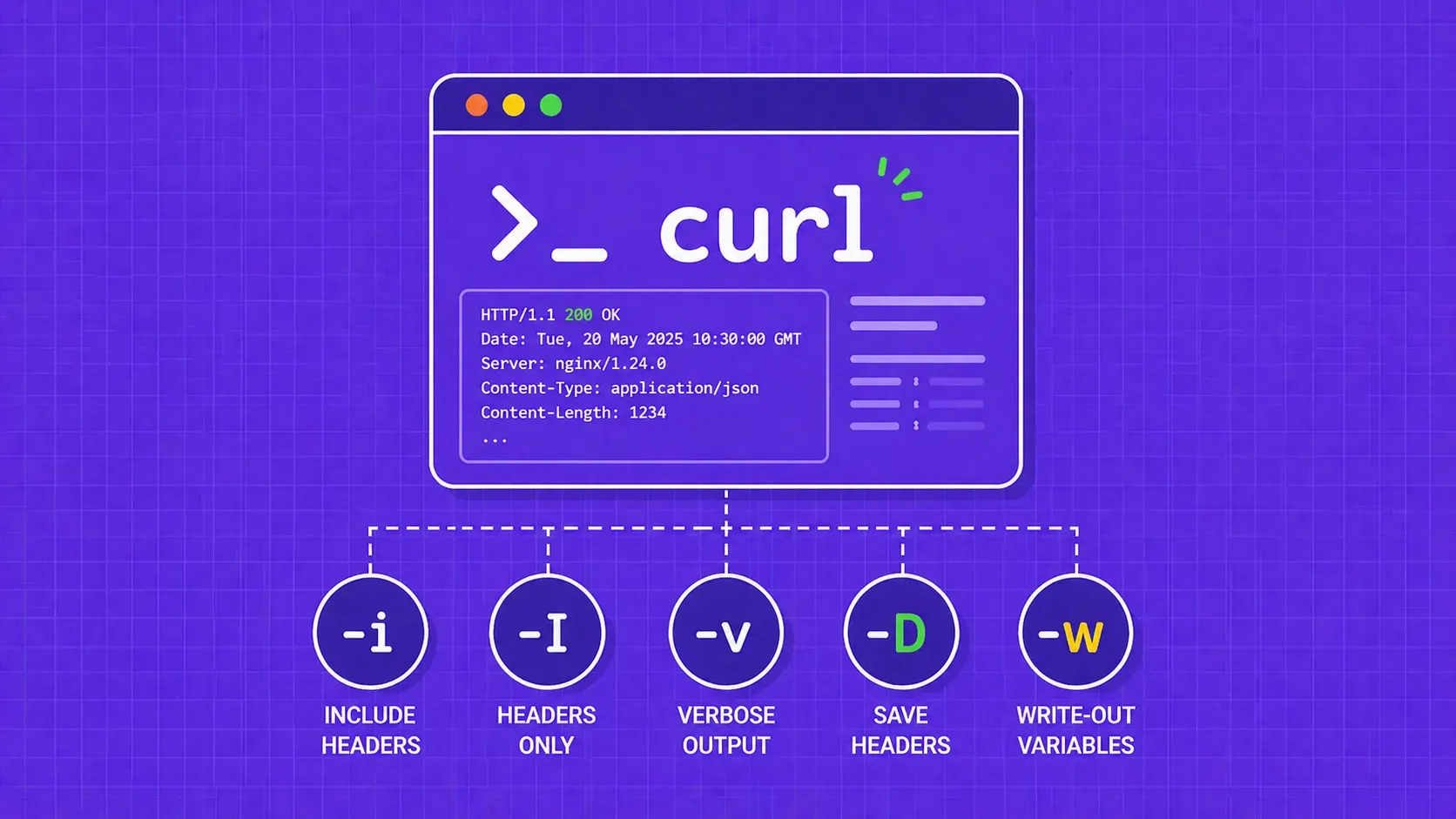
TL;DR: cURL hides response headers by default. Use -i to see headers alongside the body, -I for a HEAD request that returns headers only, -v for full request/response debugging, and -D to save headers to a file. For modern scripting, cURL 7.83+ lets you extract individual headers or dump all of them as JSON with the -w write-out option.

Suciu Dan11 min read
Read Article

Start Building

Ready to Scale Your Data Collection?

Join 2,000+ companies using WebScrapingAPI to extract web data at enterprise scale with zero infrastructure overhead.