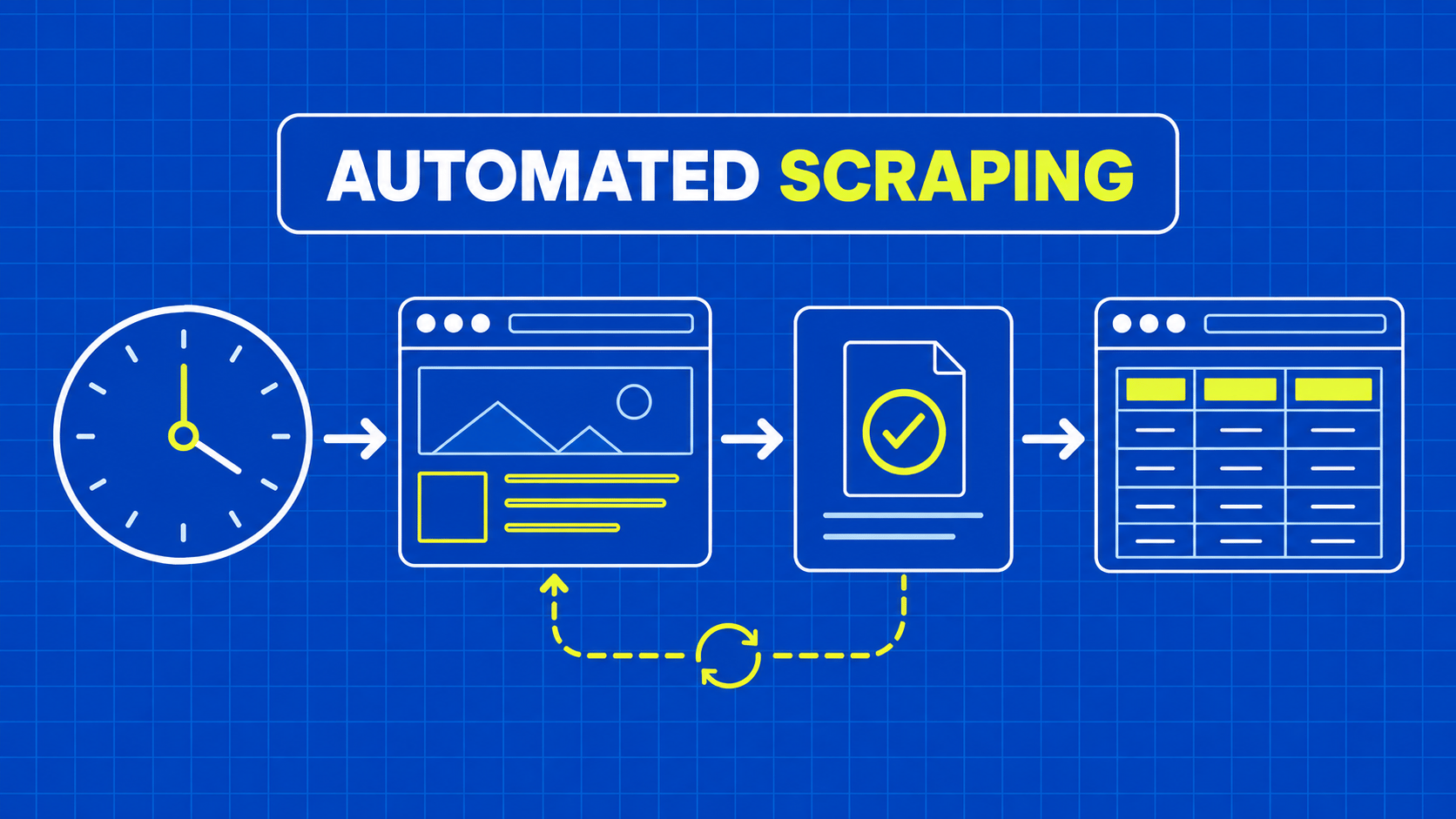
TL;DR: Automated web scraping needs more than a timer around a script. Separate scheduling, collection, validation, and delivery; give each run an identity; and design retries so failures do not silently duplicate records or erase coverage. Measure usable data and freshness, not only successful requests.
A scheduled collector finishes without an exception, but its export contains yesterday's data and half the expected products. The script ran. The data job failed. That distinction should shape the system before you add more sources or increase concurrency.
Automated web scraping is the repeated collection and transformation of website data through a defined, unattended workflow. A production job also needs a way to recognize incomplete results, recover interrupted work, and explain what it delivered. Otherwise the automation only makes the same uncertainty recur on a schedule.
For developers, the most useful starting point is a run contract: what sources are in scope, what counts as a valid observation, where results go, and which failures should stop delivery. A collector with those boundaries is easier to operate than a larger crawler whose only success signal is an exit code.
This guide walks through that architecture using a recurring catalog collection as the example. The patterns also apply to public directories, job listings, and change-monitoring datasets. The emphasis is on scheduling and recovery semantics, not a promise that any website can be scraped automatically or that automation removes the need for review.