Skip to content
Start free
Back to Blog

Octoparse Alternative: Compare Four Options

Gabriel CiociLast updated on 13 min read
Octoparse Alternative: Compare Four Options
TL;DR: Choose an Octoparse alternative around the work you want to change, not a generic list of features. Evaluate Web Scraper, Browse AI, Apify, and Scrapy with the same small collection job, then test who can repair it, validate its output, and deliver the result.

An extraction task worked last week. Today a detail page has moved a field, and the person who built the workflow is unavailable. The immediate question is not which tool has the largest feature list. It is whether someone else can locate the failure and restore trustworthy output. That is a useful starting point for choosing an Octoparse alternative.

Your reason for moving may be different: a preferred authoring model, monitoring rather than bulk collection, integration with an application, or ownership of the extraction code. Each changes the work your team must do. A replacement can move that responsibility without removing it, so the evaluation needs to cover more than the first successful preview.

The same field includes managed APIs and open-source frameworks in our best web scraping tools roundup.

This guide compares four concrete candidates using current official documentation and an original repairability test. It does not claim a universal winner, invent prices, or rank products by unmeasured speed. The aim is to find a data extraction workflow your intended operators can maintain after setup.

Use an authorized source sample, an expected record definition, and a real destination for the trial. Keep the incumbent available until the replacement produces accepted data and demonstrates the improvement that justified considering a switch.

Choose an Octoparse alternative around one unresolved job

First establish what your current setup already does. Octoparse's execution and export documentation describes local and cloud runs, along with file, database, and cloud storage delivery options. A fair comparison should not invent missing automation or export capabilities simply to make another product appear necessary.

Instead, identify the unresolved job. Perhaps the future maintainer prefers a navigation tree to a visual sequence. Perhaps the result should trigger a business alert when something changes. Perhaps the extraction logic belongs in a repository maintained by engineers. These are specific requirements that can support a meaningful Octoparse alternative shortlist.

Describe the expected improvement in an observable sentence. “A second analyst can repair a changed field and confirm the next delivery” is stronger than “easier to use.” “Our application can associate each imported batch with its collection run” is stronger than “better integration.” You can evaluate both statements without making assumptions about every feature in a product.

Also record the existing workflow's strengths. A working pagination rule, a carefully chosen missing-value representation, or a stable destination mapping is useful knowledge. Preserve it even when you do not preserve the original configuration. Otherwise, the replacement may recreate problems the current job already solved.

Keep a repair option in the comparison. If a modest configuration change meets the requirement, that is a legitimate outcome. The purpose of a trial is to establish which operating model fits the team, not to prove that a migration was inevitable before you began researching it.

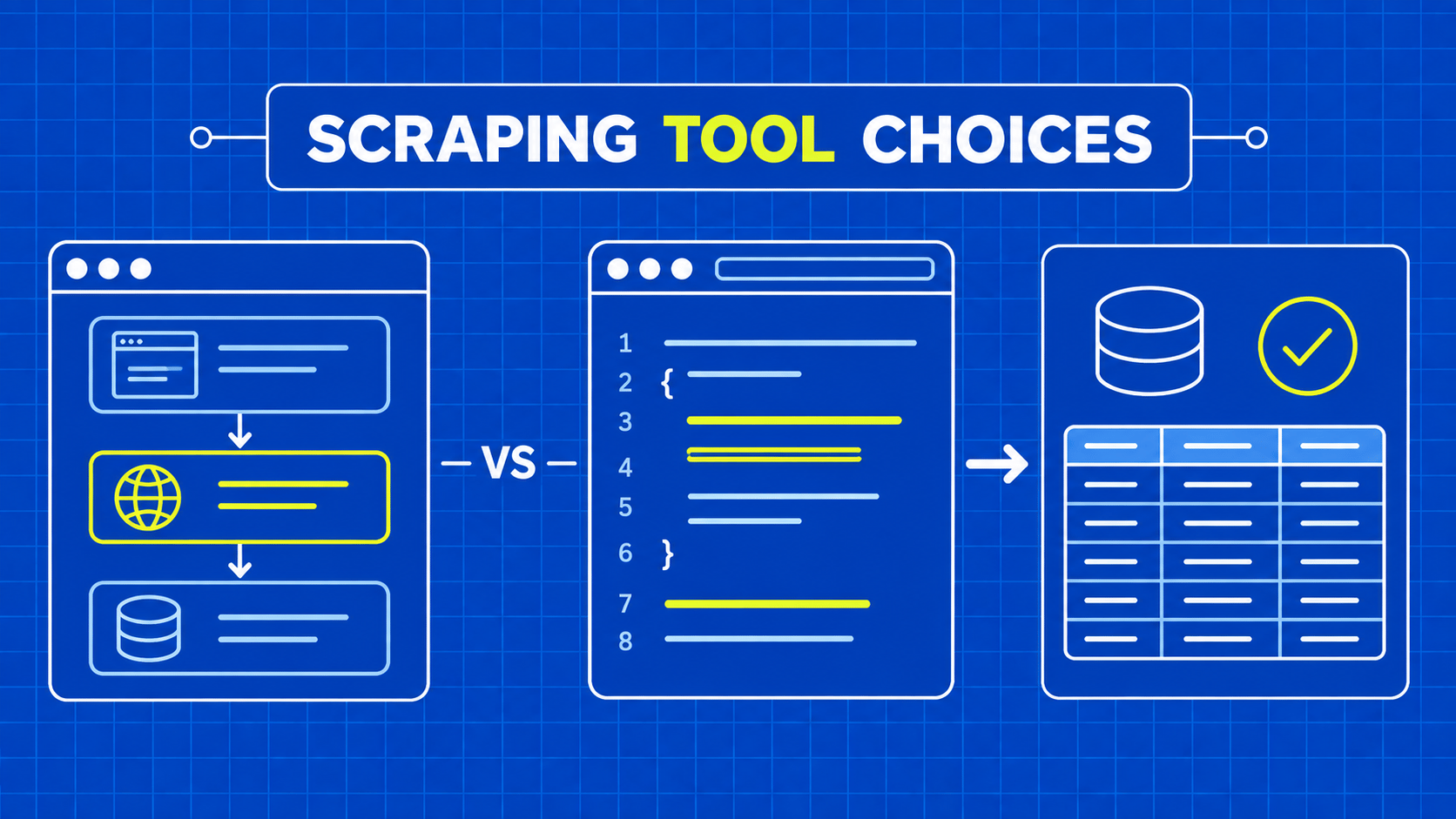
Compare four candidates by where the work lives

These candidates represent different places to define and operate collection. The table is a selection aid rather than a performance ranking. Check the current account requirements and exact execution environment during the trial, since a documented feature does not establish availability in every configuration.

Candidate

Where you express the job

Work to include in the trial

Web Scraper

A sitemap describing navigation and selectors

Review relationships and repair a navigation change

Browse AI

A trained extraction or monitoring workflow

Distinguish a changed item from a reordered list

Apify

A configured or custom hosted Actor

Validate the chosen implementation and application handoff

Scrapy

Python code and an explicit processing pipeline

Operate, test, and maintain the collector as software

Web Scraper when a sitemap makes the job easier to review

Web Scraper documents a sitemap model for navigation and extraction in its official guide. Its extension supports local configuration and execution, while Cloud runs compatible sitemaps remotely with automation features. Evaluate the relevant environment rather than comparing a local extension with a fully configured hosted service.

As an Octoparse alternative, it is worth testing when the team wants to see how starting pages, detail links, and extracted fields relate. Build one category-to-detail path and ask another operator to explain it. Then introduce a missing link or field in a controlled sample and see whether they can identify the affected relationship.

The fit depends on whether that representation makes your job clearer. A readable sitemap can help an operator understand coverage, but it does not decide what counts as a record or how an incomplete result should be handled. Keep those decisions in the acceptance notes, not only inside the configuration.

Browse AI when the outcome is a recurring observation

Browse AI's current robot-building guidance describes extraction and monitoring workflows. It recommends Table Studio for visible data and Robot Studio when actions are required, with the Chrome extension as a fallback. Use that current guidance rather than an older extension-only setup assumption.

Try this Octoparse alternative when a recurring list or change observation is the central requirement. Use a sample that adds one item, updates another, and changes display order. The resulting records should support your distinction between an addition, an update, and a harmless reorder.

The key ownership question is who reviews and repairs the workflow after launch. Training a robot does not remove the need to define identity or investigate missing observations. Have the intended operator inspect a failed or empty run and explain what action they would take before approving the monitoring design.

Apify when collection should behave as a hosted job

Apify's Actor documentation describes runnable programs invoked through the console, API, command line, or schedules. This model is relevant when collection should be connected to a larger application and treated as an identifiable job with inputs and results.

You can evaluate an existing Actor or a custom implementation. Inspect the specific Actor's output and maintenance arrangements instead of attributing every implementation's behavior to the platform. A field name that sounds right is not enough; confirm whether its value represents the source fact your consumer needs.

When testing Apify as an Octoparse alternative, include the handoff. Associate the dataset with its run, determine how partial output is handled, and make the importer wait for your acceptance checks. This option fits a team willing to own integration and validation while using a hosted execution model for the collector itself.

Scrapy when the team should own extraction as code

Scrapy is a Python crawling and extraction framework, as described in its official overview. It changes the operating model substantially: engineers define the collector and own the system around it. Treat it as a software project, not a drop-in visual interface.

This Octoparse alternative is worth considering when domain rules, version control, and integration with existing code matter enough to justify that ownership. A developer can make record validation and processing explicit; Scrapy's item pipeline documentation shows the mechanism for processing extracted items.

Include deployment, scheduling, logs, and repair in the estimate. A working local script is not equivalent to an established recurring delivery. If browser interaction is needed, design that part separately and verify the resulting page state. Choose custom code when the team can maintain it, not because the absence of a software subscription makes the operating work disappear.

Rebuild a small workflow without copying hidden assumptions

Select one collection job that represents the reason you want to move. Write down its starting scope, navigation, output fields, record identity, and stopping rule before recreating it. This produces a specification that each Octoparse alternative can implement in its own model while preserving the behavior that matters.

For example, imagine a permitted directory with categories and detail pages. One record represents one listed organization, identified by a stable source identifier or an agreed source URL rule. Its name is required; its phone number is optional. Retain the detail URL and observation time. Stop after the approved categories and results pages have been processed.

Do not silently import assumptions from the old task. A column named “location” might contain a city on one page and a complete address on another. An apparent duplicate might be one organization appearing in two categories. Clarify those meanings with the data consumer before deciding whether the replacement's output is equivalent.

Requirement

Question to answer before rebuilding

Source scope

Which categories, pages, and account context are approved?

Record identity

What makes two observations refer to the same entity?

Field meaning

What does each value represent, including missing values?

Navigation

Which links or actions lead to the required detail?

Termination

How does the job recognize the end or a permitted limit?

Delivery

What makes a batch acceptable to the consumer?

Keep a small manually reviewed sample beside that specification. It should include an ordinary record, a missing optional field, and an item reached through pagination. This gives you something concrete to compare when a replacement returns different counts or values.

For authenticated collection, document the necessary session context without copying secrets into the specification. The guide to HTTP cookies provides background on why session state can affect the response. A credential that works locally does not prove the same context is present in a remotely executed job.

Test repairability with three controlled changes

The first trial proves setup. The second should prove maintenance. Use a local fixture or a source you control to introduce three small changes: move an optional field, add another page of results, and remove a required value from one record. If you cannot change the source, choose existing representative cases that exercise those conditions.

For each Octoparse alternative, have the future maintainer inspect the outcome before giving them the answer. Can they tell whether the problem happened during navigation, extraction, or validation? Can they repair the affected rule without disturbing unrelated fields? Can they produce evidence that the next run is correct?

Record what happened rather than assigning an unexplained score. Note the symptom, the diagnostic evidence, the required change, and whether the expected sample passed afterward. Repair time is useful only when the task and operator context are recorded with it. A single trial should not become a universal speed ranking for a product.

Test a missing required value differently from an optional blank. The first may make the record unusable; the second may be a valid observation. A tool that returns both as empty strings has not made that decision for you. Your acceptance layer should preserve the distinction and keep invalid records from silently entering the downstream dataset.

Also verify a repeat run with no source changes. If the output differs, determine whether the difference reflects observation time, ordering, unstable source state, or a real extraction defect. Compare stable identifiers and meaningful values instead of treating file byte equality as the only correctness test.

This exercise reveals whether the proposed operating model is sustainable. A replacement that only its original builder can repair may not solve the maintenance problem, even if its initial demonstration looks cleaner than the incumbent's interface.

Evaluate execution, delivery, and total operating work

Follow the result all the way to its destination. A completed run and a downloaded file are intermediate events. The consumer still needs to know the source scope, observation time, required-field status, and whether the batch is complete. Define those signals before integrating any Octoparse alternative with the production import.

Test the chosen execution mode explicitly. Local jobs depend on the local environment; hosted jobs need the right inputs and source context. Confirm who can start the job, retrieve its output, and change its configuration. Keep test credentials narrowly scoped and separate from exported records, logs intended for sharing, and sample configurations.

For an engineer-owned request layer, the comparison of Python HTTP clients is useful context when deciding how responses and sessions will be handled. Do not parse every response as the expected document without checking its identity. A login page or an error document can arrive where the collector expected a directory entry.

Import the sample into the real destination's test environment. Verify identifiers, dates, missing values, and repeated imports. If the same batch arrives twice, the consumer should recognize it or otherwise follow an explicit rule. If the job produces a partial batch, it should not quietly replace the last complete accepted dataset.

Calculate costs only after defining this workload. Use current provider terms for the applicable account and include configuration, maintenance, execution resources, storage, and import work. This guide does not quote prices because a plan name alone cannot establish the total cost of your particular source and delivery requirements.

Compare retained responsibilities honestly. A hosted platform may remove machine operation while leaving schema validation with your team. A framework may give engineers control while adding deployment work. The decision is easier when those responsibilities are visible rather than hidden behind “managed” or “free.”

Move accepted datasets through a staged cutover

Preserve the current configuration and a recent accepted output before switching. Run the selected Octoparse alternative on one bounded source group and compare it against the approved sample. Keep deliberate schema changes separate from unexplained record differences so the consumer knows what is changing and why.

When a visual scraper keeps returning the wrong variant or price, our WebHarvy alternatives test runs four tools against the same pages.

Require evidence for the original improvement. If the goal was maintenance, the repair exercise should pass. If it was an application handoff, verify the complete run-to-import path. If it was monitoring, confirm the intended change semantics. Passing ordinary extraction alone does not establish that the migration solved its motivating problem.

Identify the first accepted replacement batch and the person who approves it. Document what would cause a hold or rollback, such as missing required fields, unexplained source loss, or a stale delivery. Keep the previous path available while investigating those conditions instead of disconnecting it after one successful run.

Expand by workflow once the first segment is stable. Different page structures may require separate tests even within the same source. Preserve the decision notes and acceptance examples so the next operator can understand the replacement without recreating the original evaluation from memory.

Key Takeaways

  • Choose an Octoparse alternative for one specific improvement and acknowledge the incumbent's documented capabilities fairly.
  • Compare Web Scraper, Browse AI, Apify, and Scrapy by authoring model and retained responsibility.
  • Rebuild the intended behavior from a record and navigation specification, not from undocumented assumptions.
  • Test maintenance with controlled changes, then verify the final import rather than stopping at extraction.
  • Use current workload-specific costs and a staged cutover with explicit acceptance and rollback rules.

FAQ

Can I keep two extraction tools during a transition?

Yes, provided their responsibilities and output identities are clear. Keep evaluation runs separate from the accepted production feed, and avoid duplicate collection beyond your approved source limits. A temporary overlap can provide comparison evidence, but assign an end condition so the transition does not leave two unexplained sources feeding the same consumer indefinitely.

Does an exported CSV preserve the extraction configuration?

No. A CSV usually represents output values, not the navigation and processing decisions that produced them. Preserve configuration through the tool's supported method and keep a human-readable behavior specification as well. That specification should explain source scope, field meaning, and missing-value rules so the result can be reproduced even when configuration formats differ.

Should historical data be rewritten to match the new schema?

Only through an explicit, reviewed transformation. Preserve the original meaning and observation context, and identify values that cannot be reconstructed from older records. A new field definition does not make historical values equivalent automatically. Keep transformed results distinguishable from original observations so analysts can understand any limits in comparisons across the migration.

Conclusion

The strongest Octoparse alternative is the one that improves the work your team actually needs to do. That may mean clearer visual collection, a useful monitoring workflow, hosted jobs, or custom code with explicit validation. The right choice follows from a small accepted dataset and evidence about maintenance, not a universal ranking.

Pick two candidates whose operating models fit your people. Rebuild the same bounded job, introduce the controlled changes, and inspect the delivery at its real destination. Keep the existing workflow available until the replacement demonstrates both correctness and the improvement that motivated the search.

If engineers will own parsing and acceptance, evaluate WebScrapingAPI's Scraper API as a fetching-layer option within that authorized pilot. Include it in the same response, record, and delivery checks. A maintainable replacement is a complete process with clear ownership, not simply another place to click Run.

About the Author

Gabriel Cioci, Full-Stack Developer @ WebScrapingAPI

Gabriel Cioci

Full-Stack Developer

Gabriel Cioci is a Full Stack Developer at WebScrapingAPI, building and maintaining the websites, user panel, and the core user-facing parts of the platform.

Start Building

Ready to Scale Your Data Collection?

Join 2,000+ companies using WebScrapingAPI to extract web data at enterprise scale with zero infrastructure overhead.